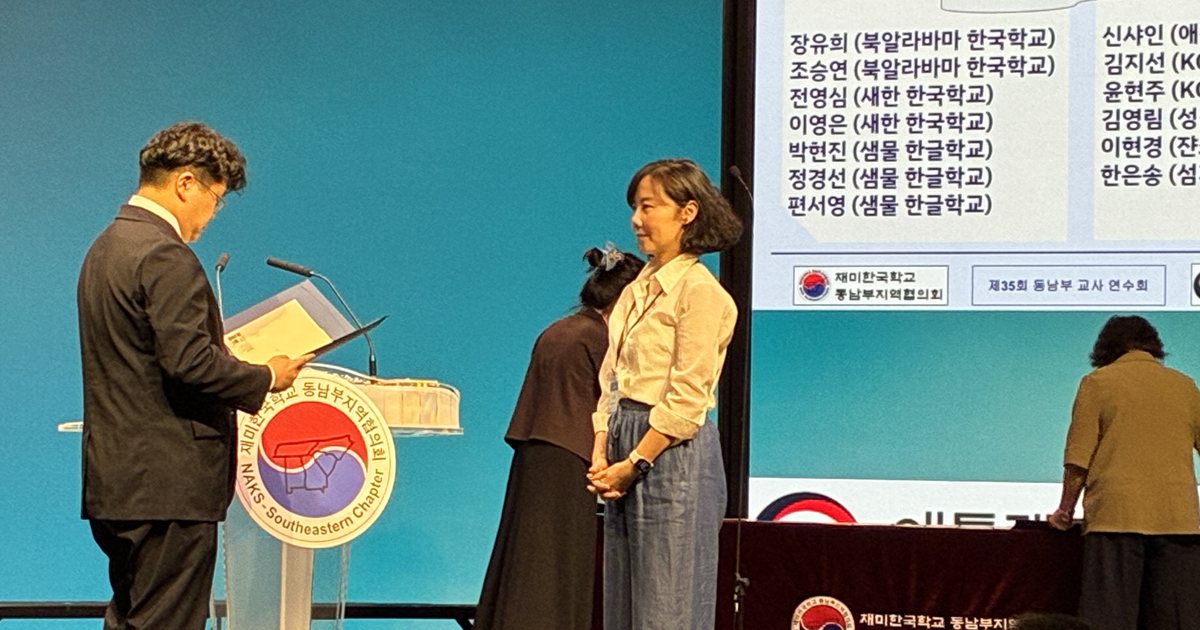
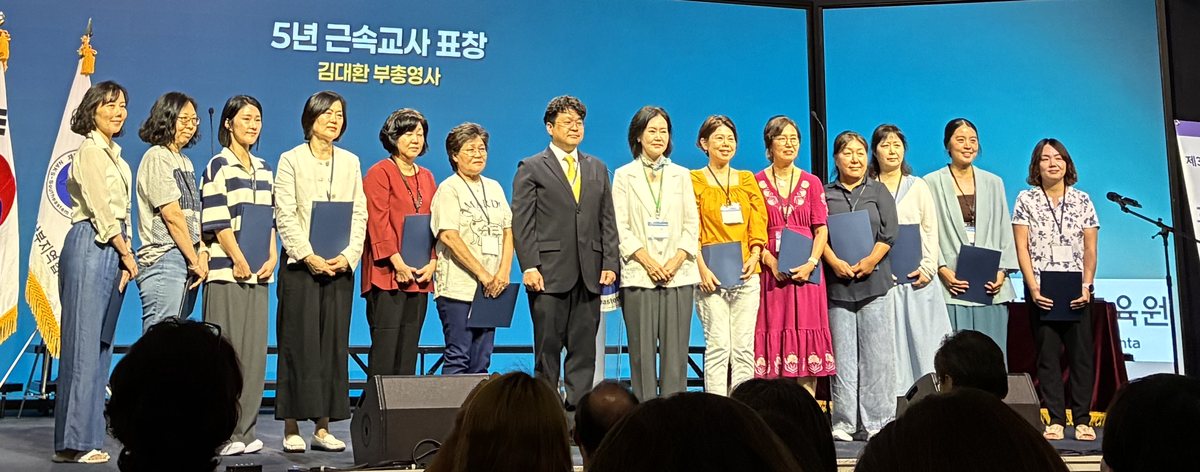
On August 1, our school's Vice-Principal Lee Owen (이지숙), together with teachers Cho Seung-yeon (조승연) and Lee Sun-ok (이선옥), attended the 35th Southeast Regional Teachers' Workshop, hosted by the NAKS Southeastern Chapter. Before the lectures began, the opening ceremony brought a welcome awards presentation. Cho Seung-yeon was among fourteen teachers from across the Southeast region honored with a five-year long-service commendation. Deputy Consul General Kim Dae-hwan of the Korean Consulate General in Atlanta presented the certificates in person, expressing his gratitude for the teachers' dedication and hard work. Jang Yu-hee (장유희), who worked alongside them for our students for many years, recently moved to Maryland and could not attend, but there was a warm moment as her fellow teachers shared in her joy and accepted her commendation on her behalf.
The keynote lecture was given by Professor Ahn So-hyun of Kennesaw State University, on the theme "Global Citizenship Education for the Next Generation: Solidarity and Reflection in Asian American History." Professor Ahn emphasized that "knowing yourself and understanding your own roots is where respect for others begins," explaining that the history of Korean Americans should not be viewed in fragments but understood within the larger historical context of Asian America. Her message — that only when we rightly understand our own identity can we grow into true global citizens who respect other cultures and other people — resonated deeply with the teachers who attended.
In the breakout sessions that followed the keynote, teachers learned a range of teaching methods suited to their own classes and shared ideas they could apply directly in their lessons.
In the first block, Park Jin-hee of Bethel Korean School presented "Picture Books, the Secret Weapon of the Hangeul Class: Building Varied Hangeul Lessons with Picture Books," introducing creative approaches to Korean-language teaching built around picture books. Kim Hee-jin of Atlanta Korean School followed with "Seasonal Song Play Using Korean Traditional and Folk Children's Songs," sharing enjoyable ways to run a class around our traditional music.
After lunch, the second block took an in-depth look at teaching methods tailored to students' levels. For the introductory, foundation, and bridge classes, Vice-Principal Jeong Hye-ju of Sugarloaf Korean School presented "First Steps in Hangeul." For the beginner class, Lee Kyung-sook of St. Andrew Kim Korean School introduced a range of methods through "Lively Hangeul Grammar That Brings Speech to Life," helping students take up grammar naturally while building their ability to speak.
For the intermediate and advanced classes, Choi Moon-jung of Atlanta Korean School presented "Korean Beyond Speaking, Korean for Thinking and Expressing: Developing Language Ability and Cultural Identity in Korean American Youth." She set out a direction for developing Korean not merely as a tool for communication but as a language for expressing one's own thoughts and identity, and it became a meaningful time of sharing perspectives with the teachers present on the questions of language and cultural identity that so many Korean American young people are working through today.
More than a day of learning new teaching methods, the workshop was a precious time for teachers walking the same path to share their experiences, encourage one another, and gather strength to return to the classroom.
Our long-awaited fall term begins soon. Our teachers have come home from the Atlanta workshop carrying new learning and new challenges, and they are waiting for their students and parents with eager hearts. We hope the teaching approaches and the warm fellowship gathered at this workshop will settle naturally into our classrooms this term, becoming the ground in which our students learn with greater joy and grow with greater confidence.
This fall as well, at the North Alabama Korean School, we will build a precious season of learning together and growing together.